Featured

BULBUL CAN SING

A Review, an Analysis of RIMA DAS diectorial film which was screened at MUMBAI FILM FESTIVAL 2018.
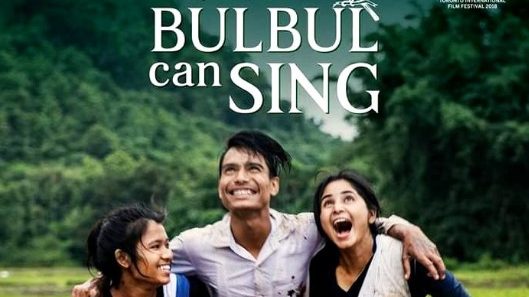
Language – Assamese, Runtime – 118 minutes

a film review written by PARAKRAM SINGH.

I’ve seen a lot of coming of age dramas from Indian Cinema either it be Udaan, Wake up Sid, or from the west Good Will Hunting. Some of the coming of age film works miraculously as they have a relatability factor, but some coming of age dramas fails as they forget in their way what it went out to deliver.

‘Bulbul can Sing’ is set in rural Assam and starts off with establishing the friendship of three friends – Bulbul, Suman and Bonny. Here Suman is a boy who spends most of his time with these two girls – Bulbul and Bonny. They have deep friendship with each other and we can see that they help each other and be with each other be it a family work or playing around. Though they must behave and help their parents like an adult, but still there is a certain kind of innocence in everything that they do. Bulbul is approached by a boy in her class whose name is Parag, through Suman. Now don’t think it’s a love triangle, the film makes it clear in the very early stages that Suman has different interests. They are living a happy life in their own world and their school. But, one turn of events changes the all three character’s lives.

As I mentioned that innocence of Bulbul, Suman and Bonny makes it a pleasant atmosphere for the film, the film changes its mood when so called religious militants while doing their moral policing harasses Bulbul and Bonny and two other boys. That portrayal of these so-called authorities works in some sorts but to what it leads to is unexplored and thus unconvincing for me.

The bio of Rima Das says that she is a self learnt film maker, but her writing is just like the writing which most of the Pixar’s film follows, you can find that template on the internet which is like –
‘once there was…everyday happens this…but, one day this happens and because of whch this happens and finally…’
That ‘finally’ for this film was missing for me. At some point film also shows the hesitation which Bulbul is having regarding her singing skills. That hesitation stays there throughout the film, and that conflict builds up as her father wants her to become a singer, but somehow that conflict is forgotten because of an incident that happens and in the end the resolution remains ambiguous for me as an audience.

The green fields and the scenes near by the river look gorgeous, but one can’t overlook shots which are out of focus or sometimes not composed that well.

As I said, Bulbul can Sing works for me in parts, but left me a bit unsatisfied as a viewer, as I was with the Protagonist who’s Bulbul throughout and in the end I was left with this question can she sing or not!
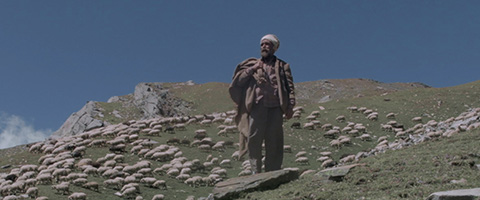
The Gold Laden Sheep and the Sacred Mountain – a Review, an Analysis

After the film ended in the theatre one of the women who was sitting beside me told me that it was such a nice film for her, I asked her if she understood the ending. She told me that she didn’t, but it does not matter to her as she enjoyed the rich visuals of Himalayas in the valley of Kashmir. What I understood was some films work for some people at different levels.

The film is about an old Shepherd who sets to find out a crashed army plane in the mountains. The mountain is considered to be sacred as there is a folklore of ‘Naga’ among the shepherds (maybe referencing to the snake of Shiv) which says that nothing can happen in that mountain without the willingness of Naga, and a rumor says that whoever goes to that mountain if found by Naga can be gulped down by the Naga himself. It’s a riveting plot for me but it does not work, why? Because there was a sense of detachment with the visuals from the beginning of the film, but that does not mean that the detachment is for the characters, the old man who banters with his helper cracks the audience sometimes but, when you see a film whose story is just half-a-page long along with too over longed sequence where we see a landscape for quite a sometime and then something enters the frame and then moves for a while and then gets out of the frame, it becomes too prolonged for me.
It is not clear to me that why that shepherd went out on that journey because I don’t see the greed in him for money that unlike the old man’s helper Bahadur who also seek out just for his greed, but as people say: greed is universal, so I can buy that thought. Or maybe the shepherd set out on this journey just to redeem himself…too philosophical! Behold your horses because the ending is rather more too philosophical, surreal and absurd for reasons which don’t have any meanings. I feel like in the pretext of abstract or philosophical endings the filmmakers try to hide their flaws in the stories and which I strongly felt for this film.
The Gold Laden Sheep and the Sacred Mountain can be a good film for someone like the lady who was sitting beside me who just loved the shots of valley of Kashmir, but for me who completed his studies in Dehradun which was surrounded by mountains, just prolonged mountain visuals don’t work for me.

SONI – A Netfix Film Review and Analysis

Soni is a film about two women police officers Soni and her Senior Kalpana from whose perspective we see the ground reality of being a women police officers and dealing with the problems that are there in the society and the system which works against them. Why I told you the basic plot beforehand is because to make one understand that it’s an important film on its own.
The feel of the film is like documentary but is the fictional account of the characters. The portrayal of Delhi and the police in general remains true to its nature. Soni is a young police officer who is good at her job but as the opening shots establishes tells the audience
that Soni is someone who takes the matter in her hands. I didn’t felt
that Soni had anger issues like her senior Police officer Kalpana says
in the establishing sequence. Soni deals with the things till the time
they are tolerable, but once they become intolerable for her she takes
the matter in her hands, literally! Thus, one of the incidents which
is an amazingly choreographed sequence where two army officers heavily drunk are stopped by the police on the road. And what follows is Soni’s reaction which lands up her in Control Room just to attend
calls (like a call-center).


Kalpana wants to help Soni, thus takes help from her husband who’s
also a police officer (very superficially explored character), but soon again Soni gets into a topsy-turvy situation which makes the system against her.
Soni’s character is straight out from the cop drama templates where
usually a male protagonist has personal issues and soon his
professional life also starts getting in trouble. Kalpana’s character arc builds throughout the film, and in end redeems itself.
There’s a scene where Kalpana asks Soni that why only she could see
such things happening which reminded me of Salman Khan’s ‘Jai Ho’ where Tabu asks the same question to Salman. ‘Jai ho’ had a over the top drama but, this film has a subtle drama and the scenes are
engaging like the opening sequence which rivets you from the very
first minute of the film.
The ending sequence where we see that Soni opens a book and reads
Amrita Pritam’s autobiography Revenue Ticket and as Kalpana elaborates in the film that a well-known writer once told Amrita Pritam that there’s nothing to write on her life and her autobiography can be written behind a revenue ticket. Thus, telling us that every woman has
her own story to tell, it can be that women that come to your house to
clean utensils or that women who picks up your call at the call centerto fix your Wifi connection. They have a story which can’t be written
behind a revenue ticket but requires deep understanding to see that
story. ‘Soni’ as a film tells a story of such people without any
exaggeration.

Jaon Kaha Bata Ae Dil – A Netflix Film – a review, an analysis

‘Jaoon Kaha Bata Ae Dil’ has a voice of its own, it has a commentary on anything and everything.

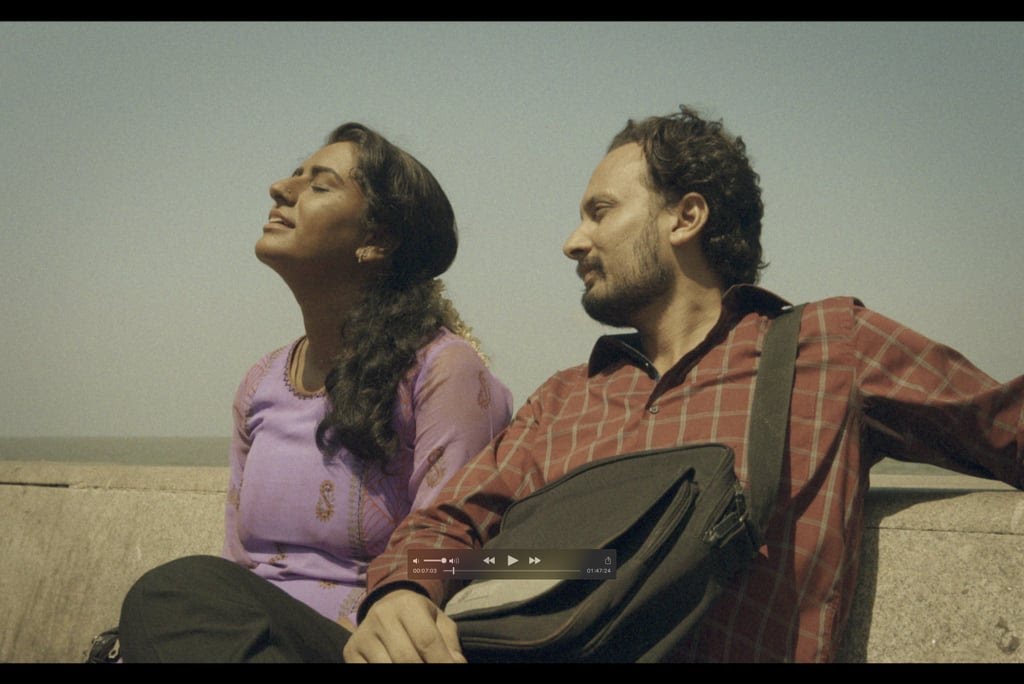
A still from the film ‘Jaon Kaha Bata Ae Dil’

When the film began, I thought this must be a mockery on romance which Hindi films generally depicts but it isn’t that only. It is about two working class couple meeting for an after-work date. They meet at Marine Drive but doesn’t talk about love they have for each other but talks about anything and everything which all makes sense when you listen to them. The film moves into different spaces – from Marine Drive to Taxi, from Taxi to a local Café, from Café to a beach, from Beach to a Hotel Room and has long one take shots to build the engagement. These spaces help us to know how their love is decaying for each other.

Both the pivotal characters are not named maybe to show they are just the ordinary ones and doesn’t require a specific identity. The conversation which we hear either between the couple, or the man and the taxi driver has a social commentary which could be heard on road, in a bus or in a local train which we are familiar with. There is a certain kind of humor that works out – like the scene where a taxi driver tries to remember one of Salman Khan’s film name, and abuses Salman Khan’s films boldly without any hesitation.

The film transits into its third act when it moves its space into a hotel room. That scene might not work for some people and may say that the girl was too submissive to his ways. But, as the film title suggests the female protagonist has nowhere else to go to seek love. She has a complex which has been built inside her because of her looks and somehow the male protagonist who’s just an ordinary person for the world but think is extraordinary uses her complex in his favor.

There’s an abstract bittersweet ending which again symbolizes that these two have no where to go to seek what they want. They’ll end up with each other. The film worked for me for most of the parts. It was the first film in the whole line up of my day which got five times audience applause, and only film where no one walked out of it till the time it ended.

The film might have left some of the audience in a topsy-turvy situation with the later one-third of the film, but I haven’t seen a Hindi language film being so outspoken about political parties, moral policing groups, freedom of expression, mirage of love that films have created, & abusive relationships. Though there is an abrupt route which the film takes but still it has the courage to take that route.

This film can disturb and distraught some of the audience but still it deserves all the applause which it earned during the screenings.

Introduce Yourself (Example Post)

This is an example post, originally published as part of Blogging University. Enroll in one of our ten programs, and start your blog right.

You’re going to publish a post today. Don’t worry about how your blog looks. Don’t worry if you haven’t given it a name yet, or you’re feeling overwhelmed. Just click the “New Post” button, and tell us why you’re here.

Why do this?

  • Because it gives new readers context. What are you about? Why should they read your blog?
  • Because it will help you focus you own ideas about your blog and what you’d like to do with it.

The post can be short or long, a personal intro to your life or a bloggy mission statement, a manifesto for the future or a simple outline of your the types of things you hope to publish.

To help you get started, here are a few questions:

  • Why are you blogging publicly, rather than keeping a personal journal?
  • What topics do you think you’ll write about?
  • Who would you love to connect with via your blog?
  • If you blog successfully throughout the next year, what would you hope to have accomplished?

You’re not locked into any of this; one of the wonderful things about blogs is how they constantly evolve as we learn, grow, and interact with one another — but it’s good to know where and why you started, and articulating your goals may just give you a few other post ideas.

Can’t think how to get started? Just write the first thing that pops into your head. Anne Lamott, author of a book on writing we love, says that you need to give yourself permission to write a “crappy first draft”. Anne makes a great point — just start writing, and worry about editing it later.

When you’re ready to publish, give your post three to five tags that describe your blog’s focus — writing, photography, fiction, parenting, food, cars, movies, sports, whatever. These tags will help others who care about your topics find you in the Reader. Make sure one of the tags is “zerotohero,” so other new bloggers can find you, too.

Design a site like this with WordPress.com
Get started